

There is an assumption driving most AI adoption conversations – more AI tools in the hands of developers means higher productivity. The logic feels alright at first glance. Coding assistants accelerate development. Development is the core of software delivery. Therefore, AI accelerates delivery. While this logic holds true at an individual level. It breaks down at system level.
Current data supports the individual win, with multiple studies showing double-digit gains for developers using tools like Cursor, GitHub Copilot, Claude code, etc. Developers report feeling faster, completing tasks sooner, and generating code more quickly. But the system those developers operate inside remains pretty much the same. Test pipelines are the same. Release processes and approval paths are the same. As a result, throughput, cycle time, and delivery predictability often stay flat.
This disconnect exists because most organizations today are not practicing AI-native engineering. Instead, they are doing traditional engineering with AI tools layered on top. And that distinction matters. Because if the system doesn’t change, faster coding doesn’t translate into faster delivery. It just shifts where the bottlenecks show up. This is what most teams are running into.
This article defines AI native engineering precisely, examines how it differs from standard AI tool adoption, and describes what it looks like when applied across each phase of the software development life cycle.
Understanding AI native engineering
AI native engineering is an approach to software development in which AI is embedded across every phase of software development life cycle (SDLC), not added on top of it. That difference matters because it changes how the system operates.
To understand this, we have to look at the structural difference between simply using tools and adopting an AI native engineering approach.
The structural difference – AI tool usage vs AI native engineering
In more organizations, AI is introduced without changing the underlying workflow. Teams continue to follow the usual steps – requirements, design, development, QA, deployment. AI is introduced mainly during the development phase (sometimes at other phases too), to speed up the execution. That approach has limits. Developers write code faster. Output increases. But nothing else adapts. This is what additive adoption looks like.
You improve a step, but the system behaves the same way. The constraint does not disappear; it shifts.
AI native engineering on the other hand starts from a different point.
Here, the entire SDLC (Software development life cycle) is structured for AI participation in mind from the start. This affects how requirements are structured and validated, how system design alternatives are evaluated, how code is generated and reviewed, how test coverage is defined, and how infrastructure is provisioned.
The change is structural, not incremental.
What actually changes in practice?
This difference shows how teams operate day to day.
| Key Operational Differences | |
| AI tool usage | AI native engineering |
| AI is added to an existing workflow | Workflow is designed around AI from start |
| Used primarily in the development | Used across all phases of SDLC |
| Prompts are reactively | Prompts are held, structured, and reviewed before submission |
| Limited context | Rule and skill files encode standards, patterns, and constraints |
| Output is used as –is or lightly reviewed | AI-generated plans reviewed before execution |
| Metric: Individual developer speed | Metric: cycle time |
Important technical note
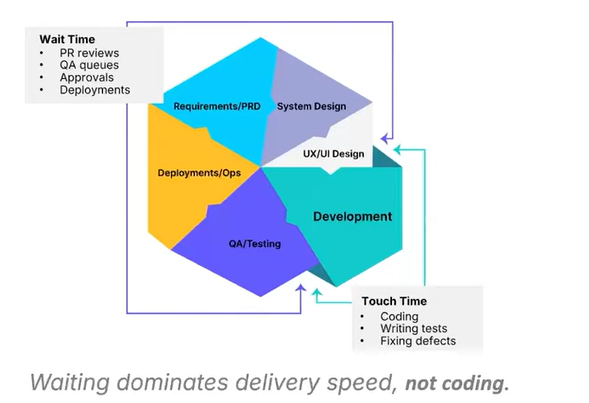
The metric that captures this distinction is cycle time the elapsed time from idea capture to production deployment. Cycle time is bounded by the slowest phase in the SDLC, not the fastest. Optimizing development without addressing QA, PR review, deployment, or requirements creates a phase-shift bottleneck rather than an end-to-end improvement.
Why does this distinction matter?
Because the productivity ceiling of AI tool usage is the development phase. AI native engineering raises the ceiling to the full delivery pipeline. By redesigning the entire delivery pipeline around AI, teams reduce friction across all phases, shorten overall cycle time, and scale delivery without increasing chaos.
AI effectiveness across the SDLC
AI effectiveness is not uniform across the software development life cycle. Based on our years of real-world experience, we have observed where AI meaningfully accelerates outcomes and where its impact remains constrained.
The ratings below reflect practical effectiveness of AI at each phase when AI native techniques are applied:
| SDLC Phase | AI Effectiveness | Leverage | Primary Bottleneck |
| Requirements | 70% | High | Ambiguity & Scope Creep |
| System design | 60% | Medium | Architectural Consistency |
| UX / UI design | 30% | Low | Human Emotion/Brand Nuance |
| Development | 80% | Very High | PR Review Latency |
| QA and testing | 50% | Medium | Environment & State Management |
| Deployment and ops | 70% | High | Configuration Drift |
Development registers the highest effectiveness at 80%, which is why it attracts the most AI tools for investment. It is also where the risk of vibe coding is highest – AI-generated code executed without plan review, producing output that may function but misses edge cases, violates architecture patterns, or introduces latent defects.
Requirements and deployment both sit at 70%. Requirements is structurally underutilized the technique ceiling is high, but adoption remains low because teams’ default to AI as a document generator rather than a structured planning agent. Deployment effectiveness is capped by a legitimate constraint: AI-generated infrastructure commands that affect production environments require mandatory human review, regardless of model capability.
UX and UI design at 30% reflect structural friction between design and engineering environments rather than a lack of AI creativity. The effectiveness is capped by the abstraction gap: prototyping tools (like Figma) operate on vector logic, while production requires component-based logic (HTML/CSS/React). Because bidirectional sync between these environments is not yet seamless, AI-generated designs often require significant manual ‘refactoring’ to align with existing production design systems. As component-aware infrastructure matures, this phase will see the most significant jump in effectiveness.
QA and testing at 50% reflects a stabilization challenge rather than a coverage gap. AI is actively used for unit testing, integration testing, API automation, and accelerating manual test case automation, but overall effectiveness is capped by instability in UI automation. Tools such as Playwright MCP give AI visual browser access for selector generation, yet selector accuracy remains inconsistent. Test quality improves when AI-assisted generation follows a phased approach: BDD feature file first, selectors next, and step definitions last.
What AI native engineering looks like in practice
Requirements and PRDs
Standard AI usage at the requirements phase produces polished but generic PRDs. The output looks complete and reads well. What it lacks is specificity: integration points with internal systems, edge cases specific to the team’s context, user scenarios that reflect actual workflows rather than assumed ones.
The failure mode is not AI capability; it is prompt quality. When requirements are generated from a few lines of input, AI fills the gaps with assumptions. Those assumptions are invisible until they cause rework downstream.
AI native practice at this phase uses planning agents that interrogate requirements before generating output. The agent asks about integration dependencies, user scenarios, and edge cases. Role assignment primes the model for the appropriate register. The ask-before-answering technique surfaces ambiguities before they become architectural decisions.
Atlassian MCP can be connected to push finalized user stories directly into Jira from the PRD, closing the loop between requirements generation and project management without manual transcription.
System design
AI native system design does not stop at generating a design document. It treats AI as a structured research and evaluation tool. Alternative architectures are requested explicitly, with pros and cons for each. The reasoning behind a recommendation is surfaced, not just the recommendation itself.
This matters because a generic prompt produces a document that misses the right database for the exact requirement, the appropriate architecture patterns, and the relevant NFRs. Asking for alternatives and reasoning converts AI from a design generator into a design reviewer, which is the appropriate role.
Rapid proof-of-concept generation is another practical application at this phase. Design choices that would previously require days of research and prototyping can be validated in hours. Research time for library selection, protocol evaluation, and architectural pattern review is substantially reduced.
UI/UX
The standard approach at this phase is manual by necessity. UX designers create Figma screens individually, produce multiple prototype variants to present to stakeholders, and iterate until a final version is approved.
Each iteration is a discrete manual effort. AI native practice at this phase replaces manual prototyping with AI-augmented prototyping. Tools such as Figma Make, Visily, and Lovable generate multiple UX variants rapidly, compressing the stakeholder approval cycle. The hold-and-prompt technique, applied to these tools as at every other phase, improves output quality from the generation step.
AI-augmented prototyping delivers genuine productivity gains at the concept and approval stage the constraint begins at the handoff to production-ready design assets, where manual effort remains unavoidable until the tooling gap closes.
Development
The development phase is where the gap between AI tool usage and AI native engineering is most operationally visible.
AI tool usage at this phase often produces what practitioners call vibe coding: a Jira ticket description is pasted into the AI interface, code is generated, the code runs, and the developer moves on. The output may be functionally acceptable. It is rarely production-grade. Corner cases are missed. Architecture patterns are ignored or applied inconsistently. Performance and security considerations are absent unless explicitly required.
AI native development at this phase is structured around following practices:
- Hold-and-prompt. The prompt is composed deliberately specifying what is needed, what context is relevant, and what the AI should not do before submission
- Plan review. The AI generates an implementation plan before writing code; the developer reviews and corrects the plan before execution begins
- Rule files. Project-specific standards, architecture patterns, library constraints, and security requirements are encoded in structured markdown files that persist across sessions
- Developer skills and judgment. AI output is not accepted by default. The developer evaluates plans and generated code against architecture, edge cases, performance, and security expectation, deciding what is production-ready and what must be corrected.
Chat context management is also operationally significant. As session grows, the accumulation of files, prior responses, and intermediate outputs creates context bloat, which degrades output quality and increases per-query cost. Keeping sessions to five to seven iterations, with focused task scope, maintains output quality and controls spend.
MCPs extend AI context beyond the local codebase. Figma MCP provides structured design data for frontend component generation, across modern frontend frameworks such as React, Angular, and Vue, significantly accelerating component output. Context7 MCP supplies up-to-date library documentation, reducing hallucinated API usage. Atlassian MCP provides ticket context without copy-paste transcription.
QA and testing
The standard approach at this phase has two consistent failure modes. First, the manual test case provided to AI must itself be correct and complete- AI automates what it is given; it does not correct what is wrong. Second, without structured setup, the QA engineer defaults to vibe coding: test scripts are generated without the constraints that produce reliable, maintainable automation output.
AI native practice at this phase applies the same disciplines used in development hold-and-prompt, planning mode, and rules files with QA-specific encoding: how selectors should be handled, where feature files should be located, and what best practices govern the automation framework in use.
Atlassian MCP points AI directly at the PRD to automate test case generation without manual transcription. Using BDD with Playwright as the framework, test script creation is decomposed into discrete phases: the BDD feature file first, selectors second, step definitions third. Each phase is governed by its own rules, producing output quality that end-to-end generation in a single step cannot match.
The 50% ceiling is a tooling stabilization constraint. Playwright MCP and equivalent frameworks give AI visual access to the live browser for selector generation- the mechanism that makes accurate element identification possible. The constraint is that accuracy is inconsistent: overly generalized selectors, global selectors, and incorrect element identification remain recurring issues. The ceiling is not permanent. It reflects the current state of tooling maturity, and will rise as stabilization progresses.
Deployment and ops
Infrastructure generation is where vibe coding carries the highest operational risk. A misconfigured Terraform module pushed to production creates incidents that are costly to diagnose and remediate.
AI native deployment practice applies the same rule file discipline used in development to infrastructure generation. Terraform-specific rule files encode best practices, resource naming conventions, security constraints, and patterns to avoid. Pipeline script generation follows explicit guidelines. AWS MCP provides live service context, cost modelling, and best-practice guidance.
Atlassian MCP provides context from deployment wikis and diagrams. All AI-generated infrastructure commands are reviewed before execution; this is non-negotiable regardless of model confidence.